Friday, July 12, 2013

Beyond Kombucha Ale

Mava Roka 7% kombucha ale.

Interview with Sprio of Beyond Kombucha podcast

Until recently we associated the word "kombucha" with "health food". But our concept of this mysterious beverage was altered and our interest was considerably piqued after we were introduced to the Mava Roka, made by Beyond Kombucha. It's a 7% ABV "Maple Vanilla Rooibos Kombucha Ale" regularly on draught at the Queens Kickshaw. On first taste we knew that it had much more in common with lambic beer than anything like wheat grass juice!


1-barrel system.

You may be wondering, "what exactly is kombucha, and what does it have to do with beer?" For the detailed history and an in depth explanation, you can refer to the very informative What Is Kombucha? page at Beyond's website. It's also addressed in the podcast. But, in short, kombucha is a raw, fermented, probiotic, and naturally carbonated tea. Like lambic beer, the beverage is fermented by different strains of yeasts and bacterias. It has been brewed in China since at least 220 BCE. Most kombuchas are very low in alcohol (.5% to 1.5% ABV), and are touted for their health benefits.

We spoke to Spiro Theofilatos, the founder and brewer of Beyond Kombucha, about his brewery. He started brewing in Astoria, near Steinway and Broadway, in 2010, and no less than two days after founding the company the federal government made an industry-shaking decision that would dramatically affect his business plans. The government decided that it would treat kombucha makers who brewed beverages with more than .5% ABV -- one half of one percent -- the same as brewers of beer. The choice was either to change his carefully constructed recipe, which created a beverage of .8% ABV, or get a brewer's license. Spiro went all in, got licensed, and, according to the QEDC and the Greater Astoria Historical Society, became the first brewery in Queens since Prohibition!


Obtaining the brewer's license allowed Spiro to, indeed, go beyond kombucha. He devised a recipe for a guten-free, sorghum malt based, 7% ABV, naturally carbonated beer. He named it Mava Roka. The beer has a dedicated line at The Queens Kickshaw, and it drinks more like a sorghum lambic than anything else! The name is an abbreviation of its ingredients:
MAple syrup, VAnilla, ROoibos tea KombuchA.


Its creation begins with a finished kombucha, which is used in place of water in the mashtun and for sparging. The beer is made from high quality sorgham extract provided by Briess Malting, vanilla, organic maple syrup from upstate N.Y. and three varieties of hops -- Challenger, Legacy and Cascade. Obviously, the probiotic aspect of the brew is eliminated after boiling the wort, but all the wonderful qualities of the kombucha -- such as the sour flavors -- are imparted to the beer. It is by far and away the best tasting sorghum beer we've ever had (and we generally have an immense dislike of sorghum beers).


B,R., Spiro, and Bob.


Spiro is working on a few new all-grain kombucha ales, including one called Y.P.A., an I.P.A. inspired bitter pale ale using his Yerba Mate kombucha in the brew. He's also soon to release his Lovers Saison, which uses his Love Potion kombucha, and is brewed with Belgian aromatic malt, Santium hops, New York City honey, and nine different aphrodisiacal herbs. 


Some noted breweries to have experimented with kombucha include Goose Island, which makes a Belgian Style pale ale called Fleur, brewed with hibiscus and kombucha tea, and Dogfish Head, which brewed Fungus Tea’Mungus for the one of the Beer Advocate Extreme Beer Fests. 
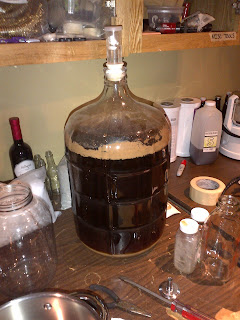
 
There are a few other American kombucha-beer brewers include Unity Vibration (Michigan), Deane's Kombucha (Minn.), Invisible Alchemy (Oregon), and CommuniiTea (Washington).
Inside an oak fermenting barrel.
Beyond Kombucha operates a one-barrel brewhouse, for brewing both the kombucha and ales, using electric heating elements in the brew kettles. Spiro considers himself a staunch environmentalist, and his brewery operates on 100% solar energy, provided by photo-electric solar panels on the brewery's roof. He said that even when his brewery is operating at it's peak level of energy consumption, he's generating surplus electricity which is sold back to the grid! 


Small batch fermenting.
Beyond Kombucha is available on a limited basis in bottles, and also on tap at places in New York like Pure Food and Wine, the Todd English bar Olives in the W hotel, The Queens Kickshaw, Eastwood, The Strand, Colicchio and Sons, Tandam Bar, and This And That.


60-gallon barrels.
5-gallon test casks.

Sixtels of Mava Roka.


Soon to be released kombucha saison.


Inconspicuous entrance to Beyond.


Sixty gallon barrel.


Delivery truck.


Warehousing room.
Straight up kombucha products.


  [link to podcast page]

Monday, July 8, 2013

Freigeist In Brooklyn


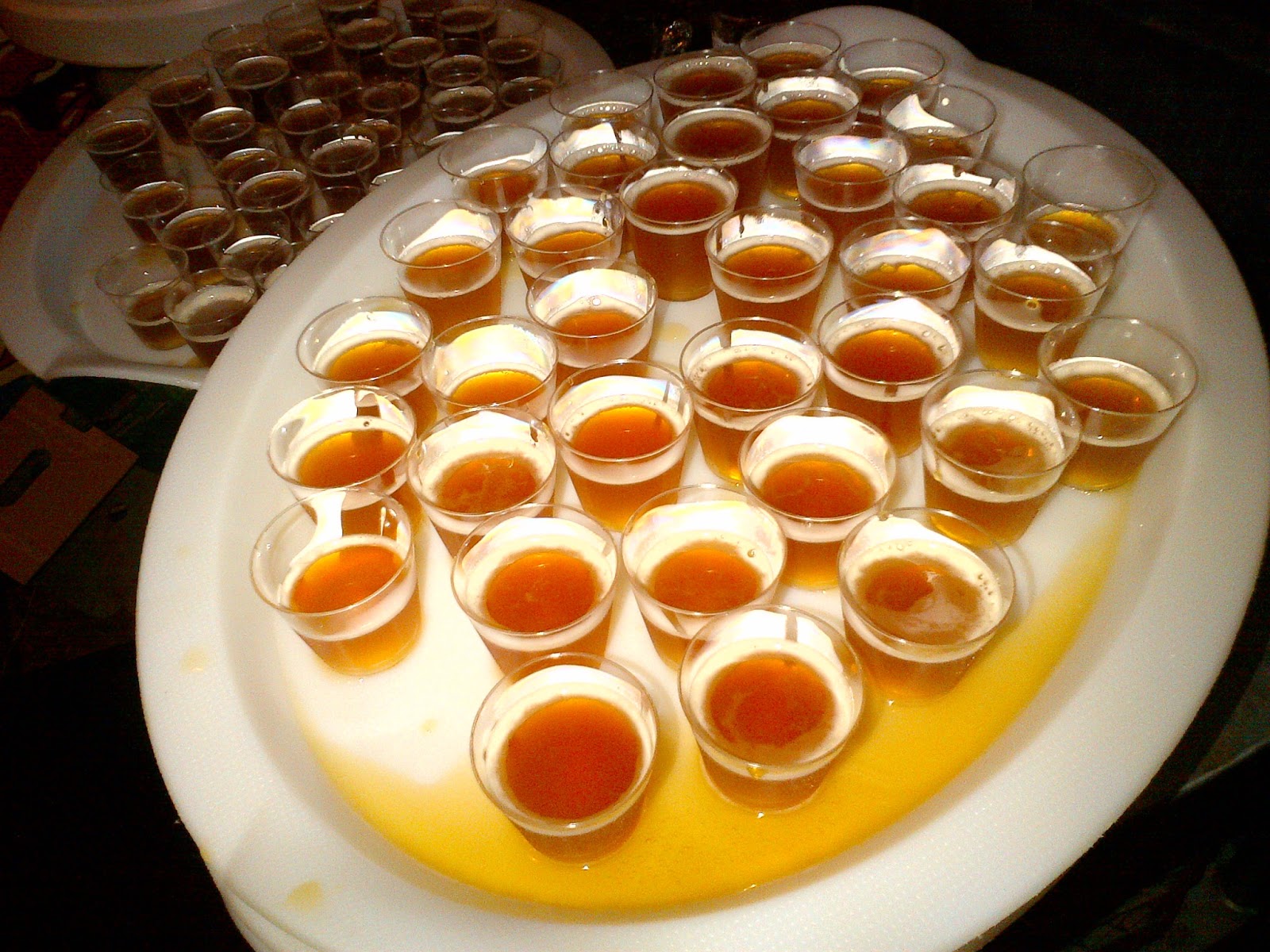
35 tumblers of beer on the tray, 35 tumblers of beer...
Freigeist's Sebastian at Bierkraft in Park Slope podcast

One of the side benefits of having a large international beerfest in our (general) area which features brewers is that they tend to make the most of their trip abroad, and end up doing some events in our little town. Such was the case following The Festival, and one such brewer was Sebastian Sauer of Freigeist from Cologne/Köln, Germany, who is also the brewer of another upstart brewery, The Monarchy. He led a tasting at Bierkraft in Park Slope, and was also on hand at Spuytin Duyvil which featured his beers as well.
Bierkraft's insane list!!!
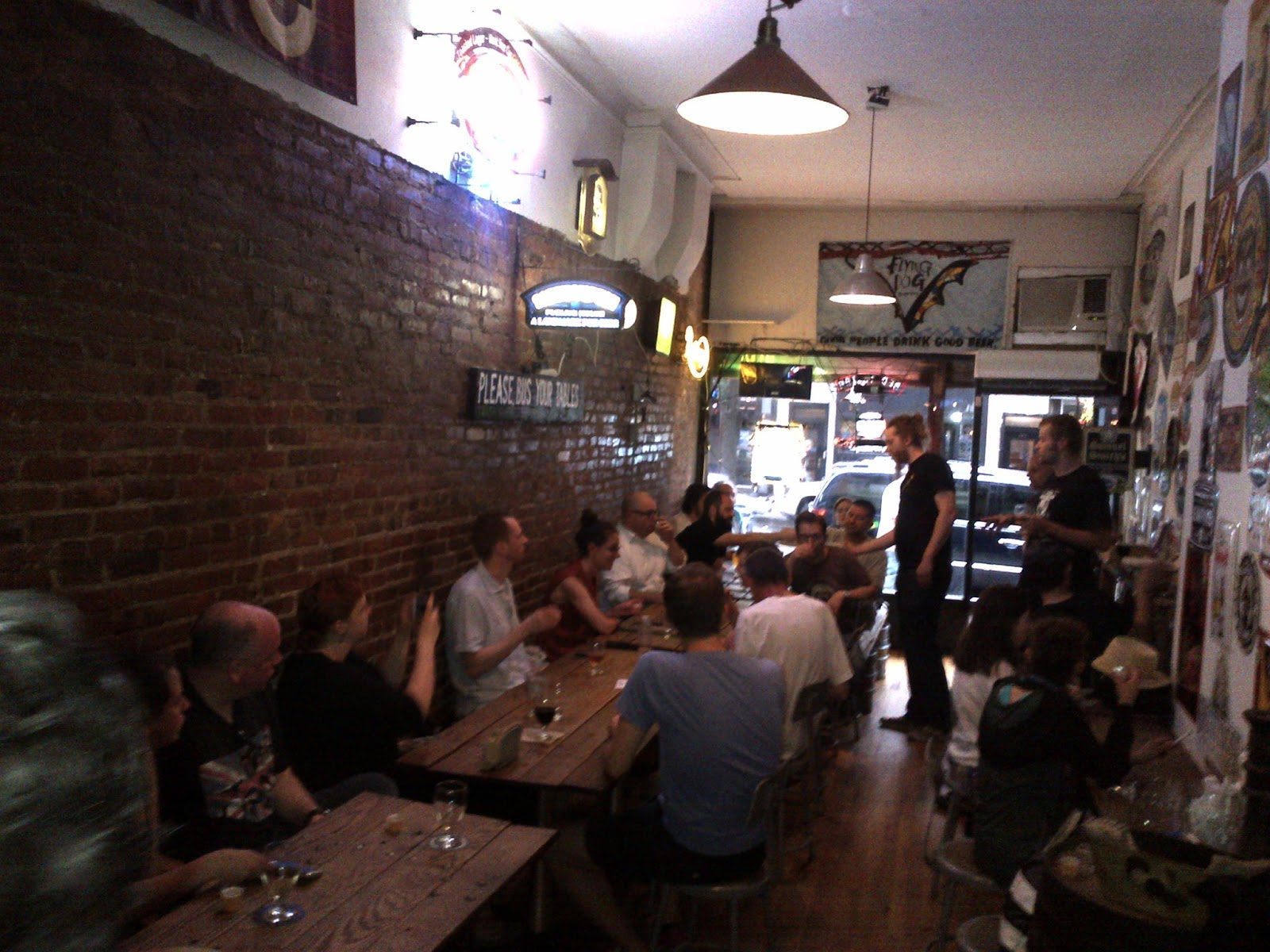
About 30 people showed up to hear Sebastian talk about the breweries and to sample 5 of the 15 Freigeist/The Monarchy beers on tap -- FIFTEEN! It's rare to see even one of these brews on draught!

Bierkraft.
Freigeist Bierkultur was founded in 2009 and first began importing to the U.S. in 2012, while The Monarchy started up last year, and makes their beers in the Dutch brewery Jopen, located in a former church. They also brew at the Braustelle brewpub in Cologne and the Vormann Brewery, situated about 70km north-east of Cologne.
Sebastian isn't as sour as his last name implies.


Most of Freigeist's products are made for export, as Germany is not a huge market for "unusual" beers that don't fit squarely into the modern German lager styles of Pils and Helles. Freigeist doesn't own it's own facility, but rents brewing time at the Cologne brewpub Braustelle, as well as other breweries (Vollman and also Göller, near Bamberg), as many other renowned craft brewers do.
L-R: Anthony of Proletariat, Joel Shelton, 
Sebastian Sauer, Chris of Bierkraft.
In addition to talking about his own enterprises and creations, Sebastian also talked about some of the obscure and nearly forgotten historical beers of Germany, which are the focus of The Monarchy brewery, as well as the Reinheitsgebot and other germane topics. He also answered the many interesting questions posed by the thoughtful group gathered. Hear his full presentation on the Beer Hear podcast!
Alternate name: A Beer Named Sue.
And I thought it was a product of England.

Grodziskie: 3.3% ABV, 5 IBU, 100% oak-smoked wheat malt
Polish style sour, bittered with willow bark.
Methusalem: 10% ABV Adambier aka Dortmunder Altbier.


Son Of A Batch: dark sour Göse, brewed with coriander
and Hawaiian black lava salt, aged in apple wood.
Munchhausen: Münsterland Altbier style, traditionally (mildly) sour.


Sauer Power ale: collaboration with Jester King.


Phoebe Caufield: this better be a rye beer!


Bierkraft backyard.
L-R: Joe from Bierkraft, Ira Glass, B.R. of Shelton Bros.


Jim spins the schlager platters.


Sebastian looks ready to bust some Schuhplattler moves.
You know, Heino!


Ottokolong at Spuyten Duyvil.


Black Smoke at Spuyten Duyvil.


Spuyten Duyvil list.


Son Of A Hickory: dark Göse sour, brewed with coriander and Hawaiian black lava salt, aged in hickory wood.
.


Rauch at Spuyten Duyvil.


  [link to podcast page]

Wednesday, July 3, 2013

Owl Farm: Brewing Network Meet-Up

Retired potato chip salesman.
On Tuesday July 2, 2013 we ventured to Park Slope to a Meet-Up organized by our pal Fritz for The Brewing Network, an on-line beer and homebrewing website resource that features articles, podcasts and, in general, seems to strive to be informational and entertaining.
Unlikely list -- in best possible way.
B.R. had been to Owl Farm before, one of a family of Brooklyn bars that include Bar Great Harry and Mission Dolores, but it was my first visit. I was surprised by the eclectic draught list. I've been to plenty of good bars with great lists, but there was a quirky randomness to their tap list. I don't think that I've ever seen anything from Beer Here, Emelisse or Alvinne on tap before, but here they were, among a wide range of breweries and styles represented on the 28 taps, plus one cask. And Owl Farm's Steven took good care of us!
Beer networkers.
I had to get the Beer Here beer, naturally. Their Dark Hops looked and drank like a Baltic porter, with a slight cocoa note in the finish and a clean, bitter aftertaste. B.R. went for the Pretty Things ¡Magnifico!, a "3.4% rustic session pale ale", which had a hazy dark golden straw color, a very hoppy, grapefruity nose (thanks to Simcoe, Horizon, Citra and Bravo hops), a very light body, with some citrus flavor up front and some graininess in the finish. The finish was extremely clean and trailed off to oblivion.
Beer Here's Dark Hops left, Pretty Things ¡Magnifico! right.
Next, B.R. tried the Oskar Blues Pilsner, Mama's Little Yella Pils, which was aged in chardonnay barrels. It had a tart, cidery aroma and flavor, and, seemingly, a very light body, though the wine attributes could have pushed perception in that direction. The wine barrel really imparted a lot of wine character -- it was quite refreshing.
Créme Brulee by Emelisse.
I, on the other hand, went to the opposite end of the scale, with a Créme Brulee Imperial Stout from Emelisse Brouwerij of the Netherlands. It had the darkest brown color with a garnet highlight when backlit with a candle, topped off with a thick, dense, tan head, which retreated rather quickly. The nose was rich and sweet with marshmallow, cream soda, and caramel notes. A bitter note peeked out from under the sweet, creamy, malt-dominated flavor, and reasserted itself in the finish and aftertaste with roasted malt flavors. It started out creamy and ended with roasty bitter finish. It's a real piece of art!


Cask version of Perennial's Aria Belgian Ale with brett.
I finished the visit with a Perennial Aria, a Belgian style ale with brett, which was on cask. The Aria had a medium golden color, and an almost pumpkin pie spice-like note in the aroma. The flavor had a hint of pleasant sourness cutting through a somewhat creamy, soft malt quality in the mouthfeel and in the flavor. Perennial is known for making beers with bold barrel aged characteristics, but this one was quite subtle and understated -- much smoother and softer in flavor than any other of their beers I've had. Perhaps being on cask, with the lower carbonation, rounded out the edges a bit. It was a good one to end with!
Three's a parliament.

Monday, July 1, 2013

De La Senne At The Festival


Interview with Yvan De Baets of De La Senne podcast

While at The Festival in Portland, Maine, we spoke with Yvan De Baets, co-owner and brewer of De La Senne brewery in Brussels. Yvan explained he and his partner, Bernard Leboucq, have a very simple brewing concept: they brew beers that they themselves want to drink, and then share them with the world. One beer that he highlighted in our brief conversation was Taras Boulba. With Taras Boulba, a 4.5% hoppy, aromatic light blonde ale, they wanted to buck the stereotype that Belgian beers must be huge in alcohol, sweet and estery. Taras Boulba, he noted, is a beer that you have when you're having more than one. (well... not exactly his words!)
Yvan also mentioned the other well known brewery in Brussels, Cantillon. He said that the two breweries are close friends and that they don't really compete with one another. Cantillon's beers are sour and dry as opposed to De La Senne's, which are bitter and dry -- if anything, they compliment each other.

While in Portland, Yvan got together with Allagash to collaborate, for the second time, in creating Very Special Belge, a tribute to the 'special Belgian', a style of beer rarely seen today. Hopefully, we'll see that beer make its way to the shelves and taps soon!
Yvan is 2nd from the right, with Jason and Rob from Allagash 2nd & 3rd from the left.


  [link to podcast page]