Showing posts with label zum schneider. Show all posts

Wednesday, April 27, 2016

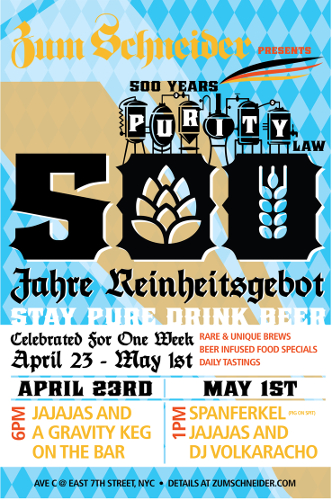
500th Anniversary of the Reinheitsgebot


http://wfmu.org/flashplayer.php?version=1&show=65880&archive=139233 Zum Schneider celebrates the 500th Anniversary of the Reinheitsgebot 

http://mofohockey.org/podcastgen/download.php?filename=2016-04-27_bh198.mp3 Non-Flash version of the podcast

On April 23, 1516 in Ingolstadt, Germany, at a meeting of the Assembly of Estates, Bavarian Duke Wilhelm IV proposed a law which dictated, among other things, that beer should only be made from water, barley, and hops. It was referred to as the "Surrogatverbot", or prohibition of surrogate ingredients, and later, in 1918, was nicknamed the Reinheitsgebot, or purity agreement.
Sylvester says "prosit!"
500 years later the law endures, and its anniversary causes us to celebrate the bright, clean, healthy lager that has defined German beer, considered by many to be the best beer in the world. Of course, some folks in Belgium and England, and other beer centric lands, might disagree. But on the corner of E. 7th St. and Ave. C in what was Kleine Deutschland in the late 1800s, German beer reigns! Zum Schneider celebrates all week long with special kegs, and a beer-centric menu featuring dishes made with beer!
Freigeist Abraxxxas makes its debut on tap at ZS!
Rather than giving you a 10 page dissertation on the history of the Reinheitsgebot, we'll just give you the short story, and link some other more in depth resources below. Basically, the law sought to preserve the quality and consistency of Bavarian beer at a time when beer was made from a long list of ingredients that varied from hamlet to hamlet. Some used different sources for the sugars, which are converted to alcohol and carbon dioxide during fermentation -- not everyone use malted grain exclusively. And the beer was flavored and colored with all kinds of things: spices, ash, herbs, roots, bark -- pretty much anything was possible. So, by limiting what could go into beer, the beer became more consistent, and the quality was more reliable.
Zum Schneider shakes up the menu with some very special offerings!
It wasn't just beer quality at the core of the Reinheitsgebot, though. The rule sought to act as a price and supply control on grain, stipulating that only malted barley be used for beer, leaving wheat for the bakers, so there wouldn't be bread shortages due to a thirst for more beer! Wheat malt was allowed in beer brewing, but on a very limited basis through special dispensation from the monarchy, and following the end of one such charter, the reigning House of Wittlesbach gave themselves the exclusive monopoly to brew wheat beer in Bavaria from 1602 to 1798.
Fraulein B.R. und Herr Bockenstein.
Here are some good sources of information on the Reinheitsgebot:

The Guardian article about a German brewery's struggle with the beer law
All About Beer article on some history
Beer Sessions Radio featuring Sylvester Schneider and Sebastian of Freigeist
Oxford Companion to Beer with its definition and history
Wikipedia always a good source
Beer and Brewing more on the Reinheitsgebot
The Ja Ja Jas.
A clean, spray-free tapping of the Weissenohe!
Jorge pours the Weissenohe.
The photographer sports a Mahr's hat as he glances at the menu specials. 

Sylvester and the ladies sing.


Wednesday, July 17, 2013

Andechs In New York


Interview with Alexander, the brewer of Andechs podcast

In late June we met with Alexander Reiss, the Brewmaster of Andechs Klosterbrauerei (Monastery Brewery) and Lars Dahlhaus of St. Killian, the importer of the beer. Alexander was in town to participate in two Andechs launch parties, one at Zum Schneider in the East Village, and the other at Z.S. Montauk. Sylvester, the proprietor of Zum Schneider, who grew up near Andechs in southern Bavaria south of Munich, has been trying to get the beer imported to New York for over ten years -- and it's finally happening! For now it's being offered on draught exclusively at both Zum Schneiders. In a few months time it'll begin to appear in New York shops and bars in bottles.
Alexander, Lars and Bob.
Andechs is the German equivalent of Chimay, Orval, et al -- a functioning commercial brewery owned and managed by a monastic order of Benedictine monks. Alexander, the Betriebsleiter/brewer, is a layman, but the monks control the brewery and make all the decisions, as they have since its founding in 1455. That's the earliest record of the brewery, though it's well established that brewing there took place as early as the 12th century.


Weißbier Hell, Doppelbock Dunkel, Vollbier Hell, Weißbier Dunkel.
The current modern brewery has a brewhouse of approximately 200 bbl, with annual capacity of 150,000hl (127,000 bbl). Alexander explained that they could probably increase capacity to more than double that, but only at the expense of their traditional, time consuming, quality producing brewing techniques. And it's quite clear -- that's not going to happen!

Andechs uses Hallertau hops for all their beers, for both aroma and bittering. Hallertau is a nobel hop used primarily as a flavor and aroma hop. It has less alpha acids than most commonly used bittering hops, and thus is more expensive to use for bittering (less alpha acids means more hops needed to achieve bitterness). But the Brewmaster explained that it's one of the things that sets Andechs apart from other breweries -- that and their use of the time-, heat- and labor-intensive traditional technique of decoction mashing. While they are distributed throughout the whole of Deutschland, 20% of their sales are from exporting. Brewer Alexander, a 23-year brewing veteran, has been with Andechs for 8 years, and he learned the trade at the famed Weihenstephan Staatsbrauerei, one of the oldest, most established, most respected brewing institutes in the world.
The monastery on the "holy hill".
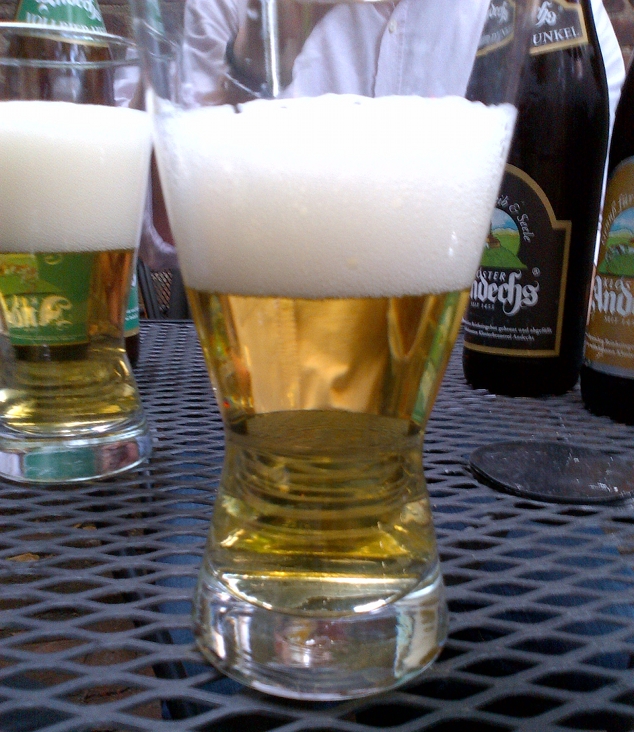
We sampled four of the Andechs beers which are soon to be imported to the U.S. for the first time ever, while sitting beneath the shady trees in the backyard of Spuyten Duyvil in Williamsburg.
Pouring Doppelbock Dunkel.
The Doppelbock Dunkel is a strong, dark, sweet, rich malty lager, historically brewed to help the fasting monks get through lent. It's mashed utilizing triple-decoction, while the other clean, traditional, rustic beers of Andechs are single-decoction mashed. 
Doppelbock Dunkel.
Weißbier Hell.
Their unfiltered Weißbier Hell is a classic Bavarian wheatbeer, with almost no banana esters, but a healthy dose of pleasant clove aroma, and a yeasty tang.
Pouring the Weißbier Hell.
The Weißbier Dunkel uses 30% dark malts in addition to wheat malt and some cara (crystal) malt. The dark malts really dominate the aroma and flavor of this very sturdy yet complex beer.
Pouring Weißbier Dunkel.
And lastly, the Vollbier Hell -- one of the most thirst quenching, elegant, beautiful beers on earth. It's got that classic Bavarian lager bready malt aroma, clean malt flavor, and a perfect medium body which satisfies without leaving a heavy feeling.


Vollbier Hell.
For now they're only bringing in Andechs draft exclusively for the Zum Schneider restaurants, but later this summer they'll be importing bottles of the four above described Andechs beers, in the same 500ml bottles that they use for the German market. Finally, you won't have to travel abroad to enjoy this extremely sought after, highly regarded, traditional yet unique German classic!
The Braumeister.

  [link to podcast page]

Andechs Vollbier Hell vom Faß at Zum Schneider.


Full line of bottles.


Friday, May 3, 2013

Maibock At Zum Schneider


[link to podcast page]
  The JaJaJas at Zum Schneider podcast

The first of May means a number of different things: ancient pagan festivals, the transition from cold to warm weather, International Workers' Day, the maypole, etc.  It also means Maibock! There are all kinds of Bockbier: Winterbock, Doppelbock, Eisbock. All of them are typically stronger (6.5% abv and up), somewhat maltier versions of amber German lager, though Maibock or Hellesbock are paler amber in color, but still darker than a standard Pils or Helles.
Ein proooosit! Ein prooooosit!
The city of Einbeck, Germany in Lower Saxony, home of the Einbecker Brewery, and situated just south of Hanover, boasts having brewed Bock first, with proof being a receipt for the sale of Einbecker beer to the city of Celle dated April 28, 1378.


Hofbrau claims to have brewed the first Maibock in Munich in 1614. That roughly matches up with the claim that in 1612 a brewer from Einbeck traveled to Munich to make the reputed “Ainpöckische Bier” for the southerners. Thanks to the regional dialect, "Ainpöckische" became “Oanpock”, and then eventually simply “Bock”. So, it seems that name Bock derives from the name of the town which first brewed it.
The Ja Ja Jas!
Both the Einbecker and Hofbrau Maibocks were pouring quite continuously this May 1 at the East Village's reconstituted Kleine Deutschland known as Zum Schneider. Both beers have that full bodied, super rich, malty profile that Bock is known for. Hofbrau's is a 7.2% Maibock with a light-medium amber color, a malty sweet aroma, and a kick of hop bitterness in the finish to compliment the hefty maltiness, quite similar to Einbecker's delicious 6.5% brew.
Mosel Franzi in action!
And no German fest is complete without lederhosen and um-pah music! Zum Schneider's Hausband the JaJaJas! were on hand to get the crowd singing, swaying and swigging with some Bavarian classics. Just the thing to get us ready for Oktoberfest!
The classic roast pig on a spit.

Tuesday, September 27, 2011

Oktoberfest Zum Schneider

WFMU's Beer Hear! with Bob W. and B.R. from 9/27/2011


Not sure if you want dark or light? Have
both with your lederhosen!
Paulaner (lighter) & Ayinger (darker).
I'm not sure about B.R.'s Oktoberfest history, but I went to Oktoberfest in München in my youth. It was horrible. If I could remember why it was horrible, I'd tell you. But I can't. And, perhaps, that's part of why it was horrible.


BR: I've never been to Oktoberfest but I do have fond memories - and some hazy ones - of biergartens in München. And, as a 5 year old, I was probably in the small minority of kids who had their own beer mug. I was so envious of my father's bier stein that my parents bought me my own fancy ceramic one for my milk.


Regardless, we can talk about a much more "gemütlichkeit" experience in the East Village, courtesy of ZUM SCHNEIDER Biergarten. It's not an outdoor "garten", but after a litre mass you might not notice, with its large windows, rustic long tables, and decorative trees winding through the space. You couldn't be in a more joyous, friendly, spirited place for the love of beer and happiness! (Not until Spaten and Disneyworld merge.) And, appropriately enough, it's located in the original Little Germany of Manhattan, which was overflowing with beergardens in the late 1800s/early 1900s, until many of the immigrants moved uptown after the worst loss-of-life disaster in NYC until 9/11.

So... what's Oktoberfest, in München or NYC, all about?

O' zapft is!
We're not going to tell you things about Oktoberfest that Wikipedia or the official Oktoberfest website can tell you. Such as, it's the largest fair in the world, with attendance of roughly 6 million people annually, or that it was founded in 1810 as sort of a wedding party for Crown Prince Ludwig.


What we'll tell you is that ein mensch in NYC has devoted his life and energy to bringing honest, heartfelt, spirited BAVARIAN CULTURE to our fine city -- Bavarian-born Sylvester "Mösl Franzi" Schneider. We interviewed him this week for the podcast. Oktoberfest is the high-holiday of Bavarian culture, which his establishment is all about, and they do it up in grand style. It's all about beer, music and togetherness. The pictures from the opening day give a good indication of what we mean.
Whoo hooo!
First, the beer of Zum Schneider -- it's only German beer, and only two tap beers are NOT Bavarian (Reissdorf Kölsch and Jever Pils). There are 12 taps of Bavarian beer, including the not so common Aventinus and Schneider Weiss, in addition to a good bottle list, that includes a favorite, Aecht Schlenkerla Rauchbier Urbock (from Franconia, in the far northern reaches of Bavarian, which some southerners say is not really Bavaria, but we like Franconia, too!).

And Zum Schneider is the only place in NYC where you can enjoy a most delicious, small regional beer from the TRAUNSTEIN brewery, located south-east of München.


During Oktoberfest, a number of taps are replaced by the likes of Paulaner Oktoberfest, Hofbräuhaus Oktoberfest, etc. -- but this year the one to try is the rich, full-bodied, uber-malty, somewhat sweet, dark amber colored AYINGER Oktoberfest! You won't find it at the München Fest because the brewery is not within the city limits (a requirement for a beer to be served at Oktoberfest). This beer is so malty, rich and flavorful, it's like drinking a loaf of homemade bread!

And it's not a party without music, so Zum Schneider's Hausband, The Ja Ja Jas, provide both traditional and original oompah band music, to get the crowd clapping, singing, shouting, swaying, laughing and fully immersed in the experience! The schedule of appearances of live Oktoberfest music at Z.S. can be found HERE.
What do you want? You want the Ja Ja Jas!!!

The Ja Ja Jas!
To complement all the fantastic German beers and raucous live music, there's a full menu of deutsches essen -- all manner of Wursts, Schweinebraten, Schnitzel, Jägerbraten. Yes, those Krauts love them some meat! But for those of us who don't partake in Rusticallefleischplatte, there is amazing Käsespätzle (order w/o bacon), Schwammerlragout, Reiberdatschi (potato pancakes), Bretzelen and plenty of tasty german salad dishes.

I've eaten a lot of German cuisine over my lifetime, in America (in my mom's kitchen, in German-themed restaurants, etc.) and in Deutschland (in Bavaria, Franconia, Pfalz, Berlin, Ruhrpott, usw.) and Zum Schneider is in my top 5 all-time best German eating experiences. The German food that I've had at Sylvester's is better than most of the German food that I've had in Germany. (Though still not quite as good as mom's! ;)

Zum Schneider is a must-visit if you want true, authentic German beer, echt German cuisine, and a healthy dose of big-hearted Bavarian biergarten kultur! In fact, I'd say, given the size and commercialism of the 200+ year old München event, Zum Schneider's Oktoberfest ist der wahre Jakob!
If this is the size of a "glass", imagine the size of a pitcher!

We're wearing leather pants. Seriously.