Thursday, October 11, 2012

Lite Beer Drinkers Trend Republican?

A chart by Tracey Robinson of the National Media Research has been making the rounds lately which illustrates the political leanings and likelihood of voter turnout based on what brand of beer people drink. In case you haven't seen it yet, here you go!

I don't know if any meaningful conclusions can be drawn from it (fans of Miller products are more likely to vote than fans of A-B products?). It definitely looks like drinkers of craft beers and imports skew towards Democrats. One thing that's not surprising -- people who drink non-craft beers are less likely voters than those who enjoy the good stuff.

I'm not sure who'll come out on top this election, but the guy currently in the White House isn't afraid to be seen downing some brew, as evidenced below. For some reason, I couldn't find one picture of the challenger having even one beer! (heh heh!)


Thursday, October 4, 2012

Dial M for Mild

[link to podcast page]
WFMU's Beer Hear! with Bob W. and B.R. from 10/3/2012

On Friday Sept. 28, 2012 Brooklyn Brewery had a release party for a beer never before made at Brooklyn, as part of the Worshipful Company of Brewers series. As Brooklyn's website explains, "The charter of this sanctified league dictates that each member of the Brooklyn Brewery brewing team will design and create a batch of his/her own draft-only beer, to be served exclusively at the Brewery Tasting Room until the last drop has been squeezed from the taps, and each with the possibility of blooming into a fully distributed Brewmaster’s Reserve."

The latest in the series is a Dark English Mild brewed by Al Duvall. Al has worked at the Brooklyn Brewery since 2011. In 1994 Al worked at Zip City brewpub, which was on E. 18th St. by Union Square, and stayed on when it became the Tap Room from 1997 to 1999. He then brewed at Heartland beginning in 2001, then Greenpoint Beer Works in 2003.


Al's Mild is a delicious, easy-to-drink 4% abv brew that provides a soft, round, comforting experience. The varied grain bill helps create a beer that is deep dark brown in color, but very easy on the palate, and low enough in alcohol to sip over a good long session. There's a pleasant hint of mild tanginess in the finish of this sturdy but gentle ale.
Just for the release party, some of the beer was infused with 9 lbs of cherries over 3 weeks. Originally, Al thought that he'd use the cherries in the whole batch, but it wasn't enough to impact the overall aroma and flavor, so he just made one keg of the sour cherry infused version of the mild. The fruit added flavor and aroma, but no significant amount of additional alcohol to the beer. Guests were offered the option to have the beer with varying amounts of the cherry-infused version added to their mug. Some opted to drink the cherry mild straight, which had a very intense flavor!
There was a cask version as well as kegs of draught available. The two versions were very similar, with the cask ale, understandably, being rounder and smoother than the carbonated style.

You can enjoy this unique, wonderful, exclusive beer at the Brooklyn Brewery tasting room on Fridays from 6pm-11pm, Saturdays from noon-8pm and Sundays from noon till 5pm. There's more on the Brooklyn Brewery blog.

Wednesday, September 26, 2012

Murray's Cheese & Beer Pairing At Brooklyn Brewery

[link to podcast page]
WFMU's Beer Hear! with Bob W. and B.R. from 9/26/2012

On Wednesday Aug. 29, 2012, Aaron Foster, one of the buyers of Murray's Cheese, was the guest speaker at Brooklyn Brewery's Legion of Osiris.

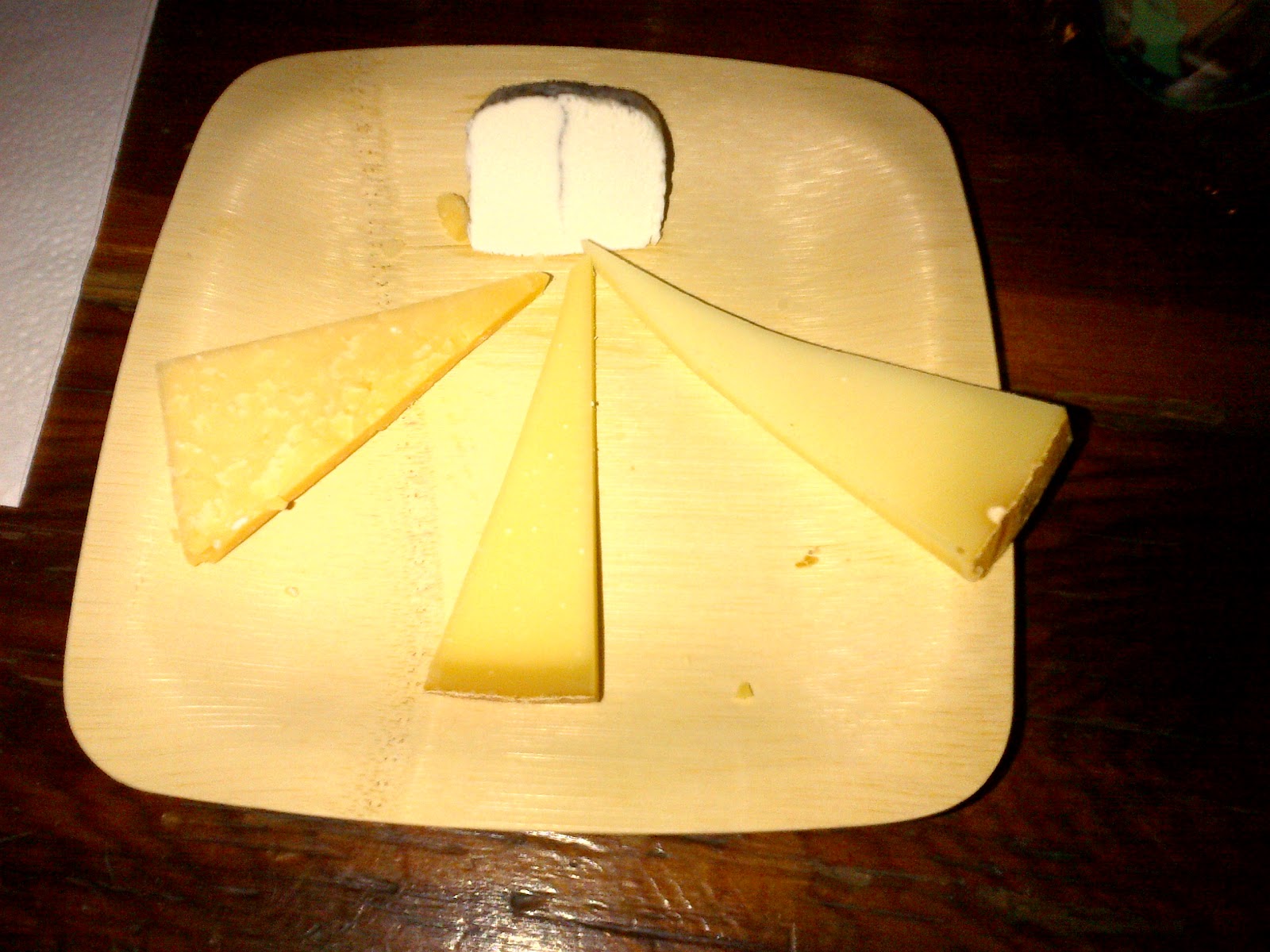
Aaron, who is also the beer buyer at Murray's, brought four cheeses to match up with four Brooklyn beers for the 50-or-so attendees.
1. Rainbeau Ridge Meridian goat cheese with Sorachi Ace

2. Ossau-Iraty Vieille with Brooklyn Brown Ale

3. Appenzeller with Local 2 (bottled)

4. Cabot Clothbound Cheddar, cave-aged by Jasper Hill with Brooklyn Blast


Hear how the beers matched up with the cheeses in this week's podcast. Warning: the main podcast is almost an hour long! You can also check out a 15 minute bonus podcast in which Aaron explains the basics about how cheese is made.


Aaron of Murray's.

Saturday, September 22, 2012

Ambitious Brew Book

Ambitious Brew: The Story of American Beer was written by Maureen Ogle, and published by Orlando - Harcourt in 2006. It's a history of brewing, breweries and beer in America, focusing mainly on the period of 1840 to prohibition. There's very little information prior to the 1800s. There is a reasonable amount of writing, though, concerning the post-Prohibition period up to the craft beer revolution of the late 1980s/early 90s.

The book focuses mainly on the major German-heritage brewers in Milwaukee and St-Louis: Best (which became Pabst), Anhauser-Bush, Schlitz, and Miller. Not much is written about Schaefer, Rupert, Ehret and other East Coast brewing giants (and no mention of Frank Jones, a US Congressman brewer from New Hampshire from the 1800s!). But, honestly, there's plenty of interesting history on the Mid-West brewers to make a good read.
By the by -- why so little info on beer prior to the first American beer revolution of the mid-1800s? Probably because Americans were drinking rum, whiskey, and hard cider much more than beer during that period.

The book zeroes in on the transition from the muddy, rustic frontier ales and English imports of porter to the dark, rich, malty German lagers, introduced by a flood of German immigrants to the U.S. in the mid- and late-1800s. Though not quite brilliant pale pilsners at that point, those hefty lagers were much cleaner and consistent than the beer that preceded them in the saloon.

Ogle also paints the scene of first generation German/European immigrants trying to re-create the European tradition for enjoying beer -- a very social setting, with the whole family in tow, in a wholesome, airy, sunny garden-park. Drinking beer wasn't about getting wasted -- it was about sipping a clean, full-bodied lager in a biergarten, with beautifully manicured grounds, on a slow, relaxing Sunday afternoon. The low-alcohol drink was more a meal than a means of intoxication.

The history slides from dark German lagers toward the pale, crisp, lighter bodied Bohemian Pilsner style beers that followed, which were inspired by Czech beers from Pilzn and Budvar, that became all the rage at the end of the 1800s. There's also much explained about the struggles German-American brewers experienced with the negative association of Deutschland at the onset of WWI, and how prohibitionists used that to further their cause.

The book tracks the American transition from substantial German lagers to paler Pilsners to what currently passes as "American beer" by tracing brewing trends and public demands over the decades. There are a lot of surprising facts -- for example, when Anhauser-Bush started using rice in the late 1800s, it was actually more complicated and more expensive than if they were to use 100% barley malt. Apparently, rice was not used then to cut costs, but to achieve a paler, lighter body.

Ambitious Brew is a fantastic resource for getting a basic understanding of how early German-Amercian brewers shaped beer and brewing in America. There's also some intriguing insight into the topic of Prohibition -- how it came to pass, how the brewing industry (barely) survived it, its repeal, and the post-Prohibition period.

This book is a very easy and fast read for anyone with an interest in brewing history. It's a must-read for beer geeks and fans American history. In addition to the obvious brewing history knowledge laid out in the text, much is revealed about general American culture, politics and power, as viewed through the history of one of the largest, most influential and ubiquitous industries in the nation.

A copy of Ambitious Brew is available for borrowing from the New York Public Library. Both new and used copies can also be found at various on-line book sellers.

Thursday, September 20, 2012

Beer For Post-Armageddon


This week NPR reports on a 1957 US government study on whether or not beer could survive a thermonuclear attack. Is beer that has been exposed to such radiation safe to drink? You just survived an atomic bomb -- just drink a beer, already!

Tuesday, September 11, 2012

Churchkey Can Co. Pilsner

BR says:  During a recent visit to The Cannibal, I came across a unique can of beer. Being somewhat of a sucker for cool packaging, I had to pick up a can of Churchkey Pilsner. And by can, I mean an old-school, steel can with no newfangled pull-tab. Everyone has an old can opener at the bottom of the silverware drawer but how often do you get to use it?
 
We took the can over to Proletariat to share with a Bartender Cory who looked bemused until we showed him the churchkey opener we had dug out to get at the suds. For something that screams "gimmick", albeit a gimmick in a really cool package with a retro design, we were surprised by the quality of this full-bodied American Pilsner style beer. It's from a new brewing company from Seattle, Wa.,  Churchkey Can Co., which contracts with Two Beers Brewery to produce a delicious, malty Pilsner.

Aside from initial foaming when opened, the beer poured a hazy dark gold and looked to be unfiltered. It had a malty aroma with some hop presence and a surprisingly full-bodied flavor -- much bigger than a traditional pils -- with solid hop bitterness in the finish. There was a bit of graininess in the finish and didn't have a clean pilsner profile but we've definitely had worse.

And Bob did a little research because BR has some terrible gaps in pop culture knowledge and the comment "isn't the guy from Entourage involved?" drew a blank stare from her:  From the company's website, "Co-founded by Portland-native Justin Hawkins [Wieden+Kennedy/Nike designer] and actor Adrian Grenier [from Entourage], Churchkey Can Co. began as the desire to someday experience a great beer in a simple can as the generations before had. Quickly realizing the flat top can was all but a memory, Hawkins and Grenier set the wheels in motion to found Churchkey Can Co."

"Our home brewers Lucas Jones & Sean Burke are the creators of the Churchkey Can co. Pilsner Recipe. They have been crafting home brewed beer in their garages for many years. They share these brews with their friends at backyard BBQs and over the holidays as gifts. They love this hobby and are passionate about their beer and the community they cultivate with it. We are very excited to have these two All-American guys create the recipe for the Churchkey Pilsner. We hope that you enjoy it as much as we do."